
September 16, 2026
In a thoughtfully designed home, window treatments should be considered as part of the architecture—not added after the walls, glass and interiors are finished. Motorized shading determines how daylight enters a room, how much of the view remains visible, how private the house feels after dark, and whether the technology disappears cleanly into the ceiling or becomes a visible design element.
Lutron’s current window-treatment portfolio is broad enough to solve very different problems: exposed Palladiom roller shades, wire-free battery-powered shades for finished homes, hardwired systems for new construction, concealed Sivoia rollers, Palladiom Drapery, standard automated drapery tracks, Roman shades, tensioned skylight systems, wood and sheer blinds, and specialty solutions built around Lutron shade drives.
Regent5 designs, engineers, installs, programs and commissions these systems for custom homes and private estates throughout the San Francisco Bay Area and Northern California. We also work with specialist fabricators and architectural partners when the opening calls for something outside a standard rectangular roller shade—including Insolroll exterior patio shades, Crown Shade bottom-up and specialty-shaped treatments, and Blindspace recessed track and pocket details.
This guide is meant for homeowners, architects, interior designers and builders who want to understand what is actually possible before the glazing, pockets, wiring and finish details are locked.
Product capabilities reviewed September 2026. Exact sizes, fabrics, controls and compatibility vary by shade family and current manufacturer documentation; final selection should be confirmed during project engineering.
The first shading decision is not fabric color. It is how the treatment should relate to the architecture.
An exposed Palladiom roller can be a deliberate architectural object. A recessed Sivoia shade can disappear completely into a ceiling pocket. A Roman shade can introduce softness and textile character. Drapery can add movement, fullness and acoustic comfort. A bottom-up shade can preserve sky and view while blocking a direct privacy line. Exterior screens can stop glare and heat before they reach the glass. Each solution solves a different problem.
That is why Regent5 does not recommend one shade family for every window. We build a room-by-room and elevation-by-elevation strategy, then coordinate the motors, power, control system, pockets, fabrics and keypads as one package.
Lutron’s professional residential portfolio can be simplified into three major design directions.
Palladiom is the design-forward exposed roller family. It is appropriate when the brackets, tube and hembar are intended to be seen and coordinated with the room rather than hidden.
Sivoia is Lutron’s broad specification-grade platform for new construction and demanding architectural applications. It is the family we look toward when a project needs recessed pockets, larger shades, tensioned applications, more complex wiring or specialty integration.
Triathlon is a strong wire-free platform for retrofit and finished-home applications. It is useful where opening walls for shade power is undesirable and the project still wants professional integration with Lutron controls.
For a focused comparison of those three families, see our Palladiom, Sivoia and Triathlon shade-selection guide. This article goes deeper into the architectural possibilities around them.
Palladiom Wire-Free is one of the most compelling solutions for a finished design-led home because it combines premium exposed hardware with battery power. Current Lutron literature lists Palladiom Wire-Free roller shades from approximately 21 to 144 inches wide and up to 144 inches high, with exact limits varying by fabric and configuration.
The drive uses D-cell alkaline batteries and Lutron’s current product literature describes typical battery life in the multi-year range, aided by Active Energy Optimization. The batteries are accessed at the shade itself, so the installation should still be planned so future service does not require disturbing delicate finishes or built-in furniture.
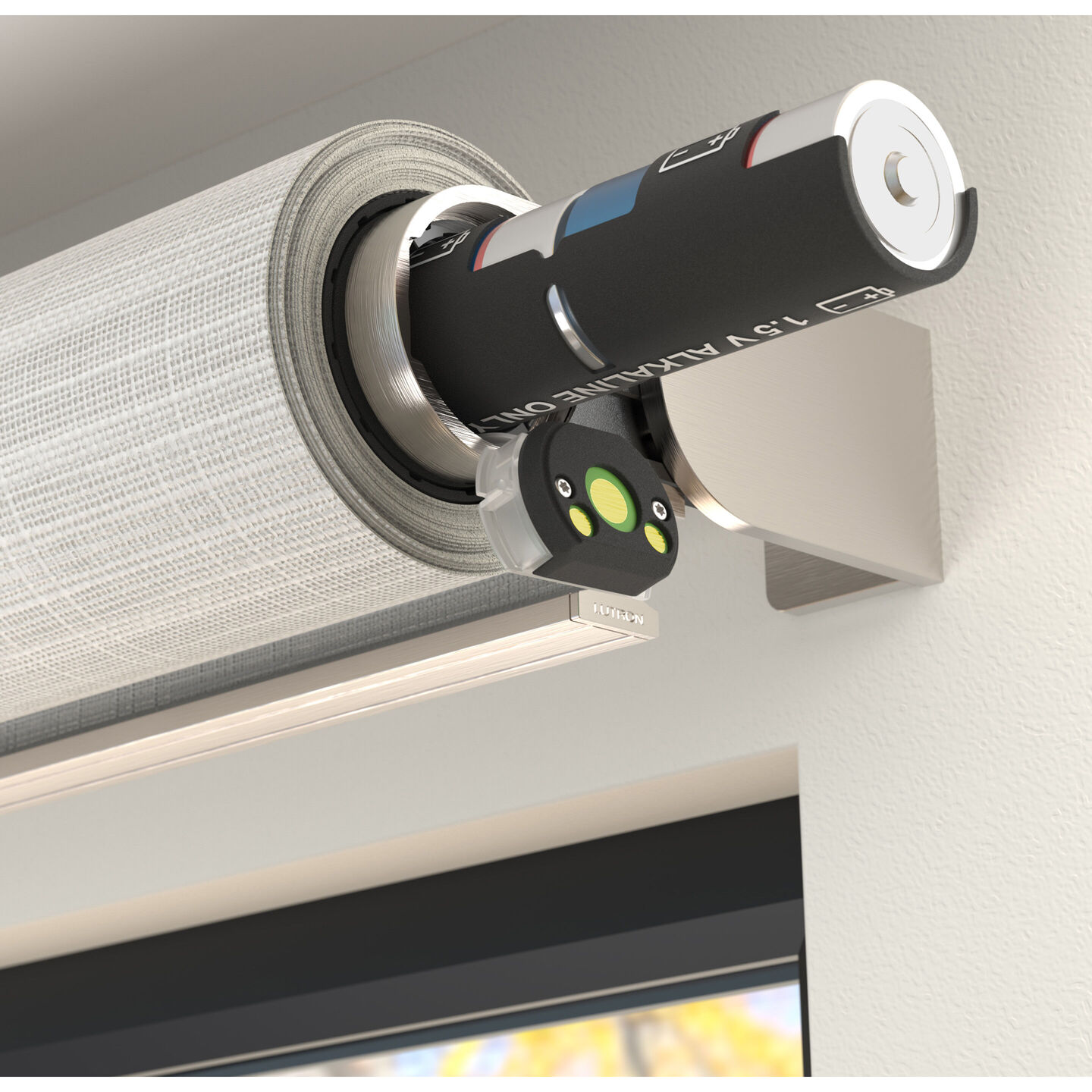
The appeal is not simply “no wires.” Palladiom’s exposed brackets, finished tube and refined hembar are meant to become part of the visual composition. That makes it particularly useful in rooms where a standard cassette would look too commercial or where opening plaster, stone or finished millwork for new power is not desirable.
Current Palladiom Wire-Free finishes include architectural options such as Pure White, Clear Anodized, Black Anodized, Satin Nickel, Brass, Satin Graphite and Aged Bronze. Fabric categories include sheer, translucent/privacy and blackout options. It communicates over Lutron’s Clear Connect RF architecture and can participate in compatible HomeWorks and RadioRA 3 projects.
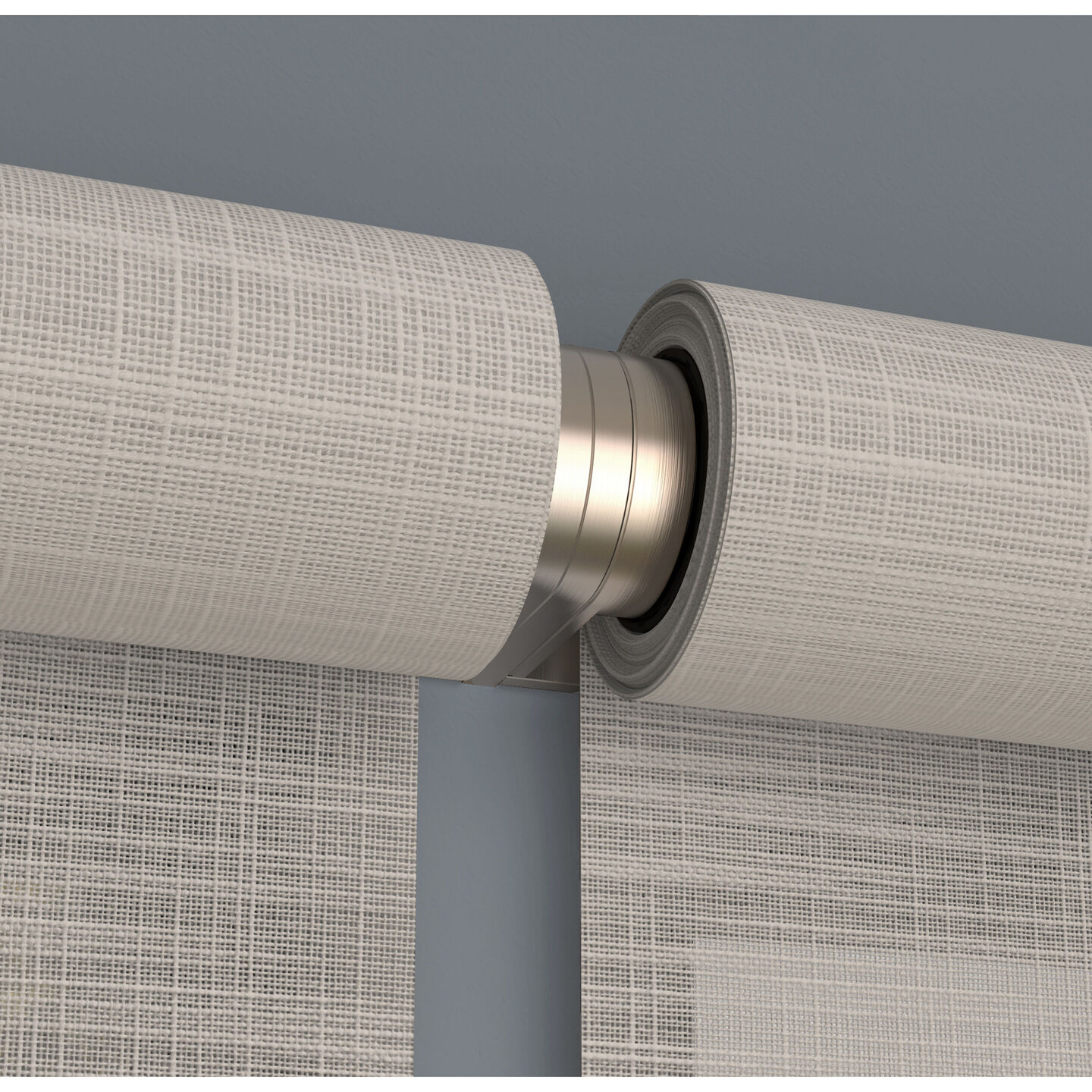
For new construction or a major renovation, a hardwired Palladiom installation can make more sense. Power is planned before the walls close, battery replacement disappears from the long-term service plan, and the shade infrastructure becomes part of the electrical and low-voltage drawings.
One useful distinction is often missed: power method and communication method are separate decisions. A Palladiom shade can be supplied with hardwired power while the control architecture still uses Lutron wireless communication in applicable configurations. The project team should not assume that “wired shade” automatically means a communication cable must run to every motor.
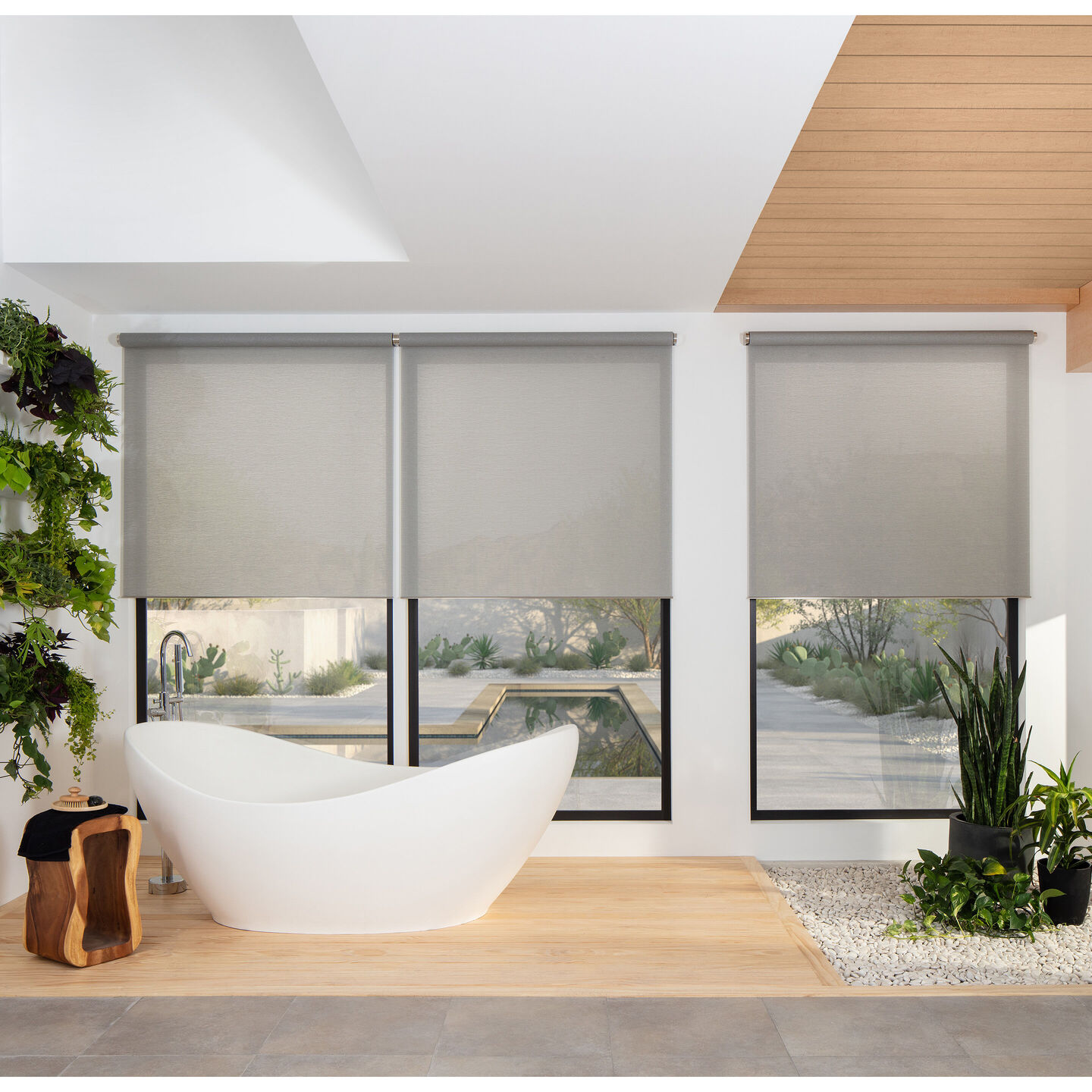
For a whole-home installation, we coordinate shade power locations, blocking, roll direction, bracket alignment, fabric selection, keypad scenes and equipment locations during design development. On a large glass elevation, an inch of inconsistency between adjacent shades is far more visible than it appears on a drawing.
Lutron’s newer Palladiom Drapery brings the Palladiom design language to fabric drapery. Instead of disguising the track, the product combines the visual refinement of a slender curtain pole with an automated drive system. It is a very different proposition from hiding a conventional motorized track in a pocket.
Current Palladiom Drapery specifications include low-voltage power, QS wired or wireless communication, and custom-fabric compatibility. The system supports left draw, right draw, center draw and tandem arrangements, with the exact drive selected according to track length, fabric weight and configuration. Current finish options include Pure White, Black Anodized, Clear Anodized, Bronze Anodized and Satin Nickel.
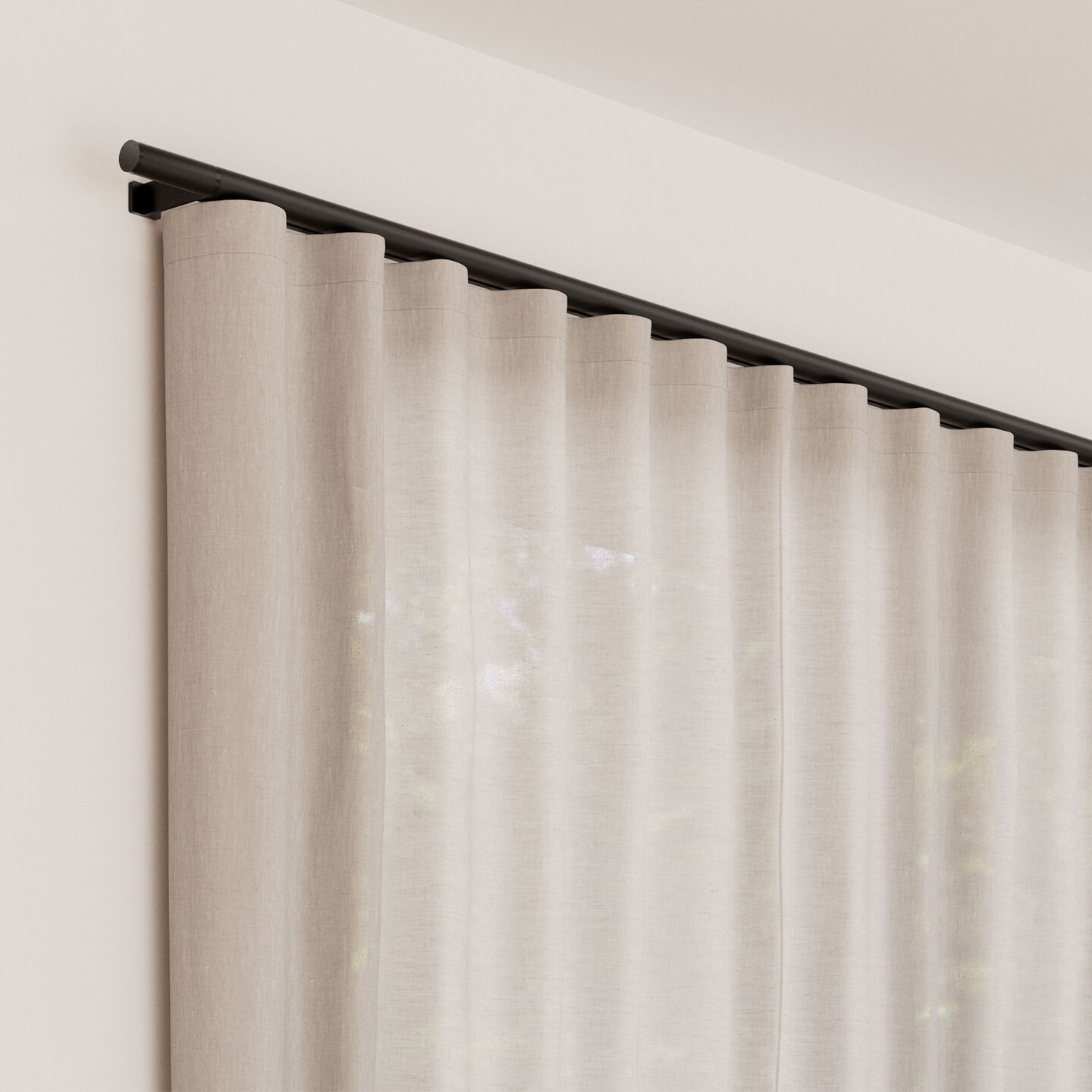
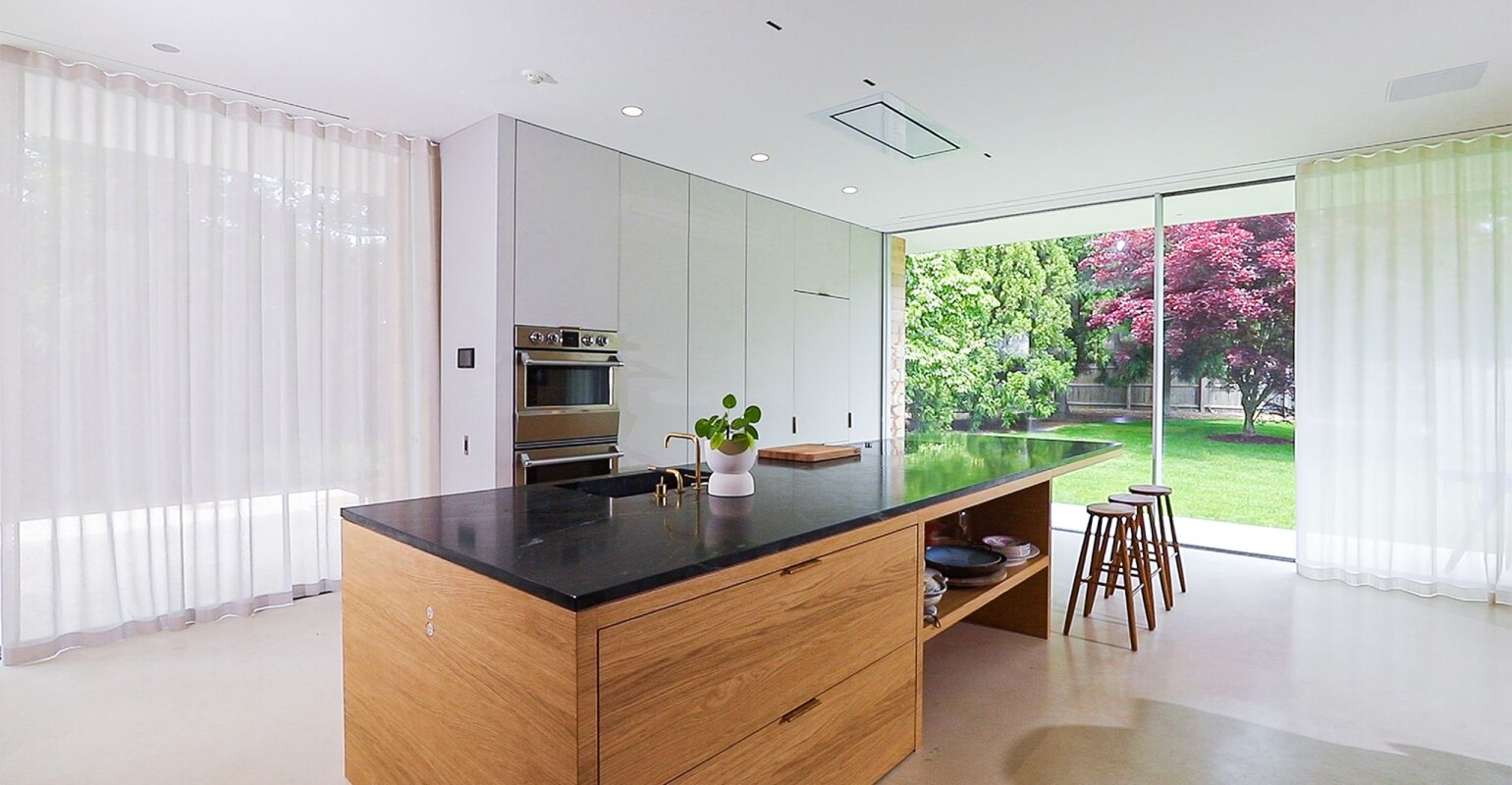
Lutron’s current drapery documentation centers on two principal heading styles: Pinch Pleat and Ripplefold. Pinch pleat gives the fabric a more tailored, structured rhythm; Ripplefold creates a cleaner continuous wave that works particularly well in contemporary interiors and large expanses of glazing.
On standard Lutron drapery tracks, pinch-pleat fullness may be specified at approximately 2x, 2.5x or 3x depending on the workroom and design, while Ripplefold commonly uses 80%, 100% or 120% fullness. More fullness creates a richer textile presence but also increases stack-back and fabric weight.
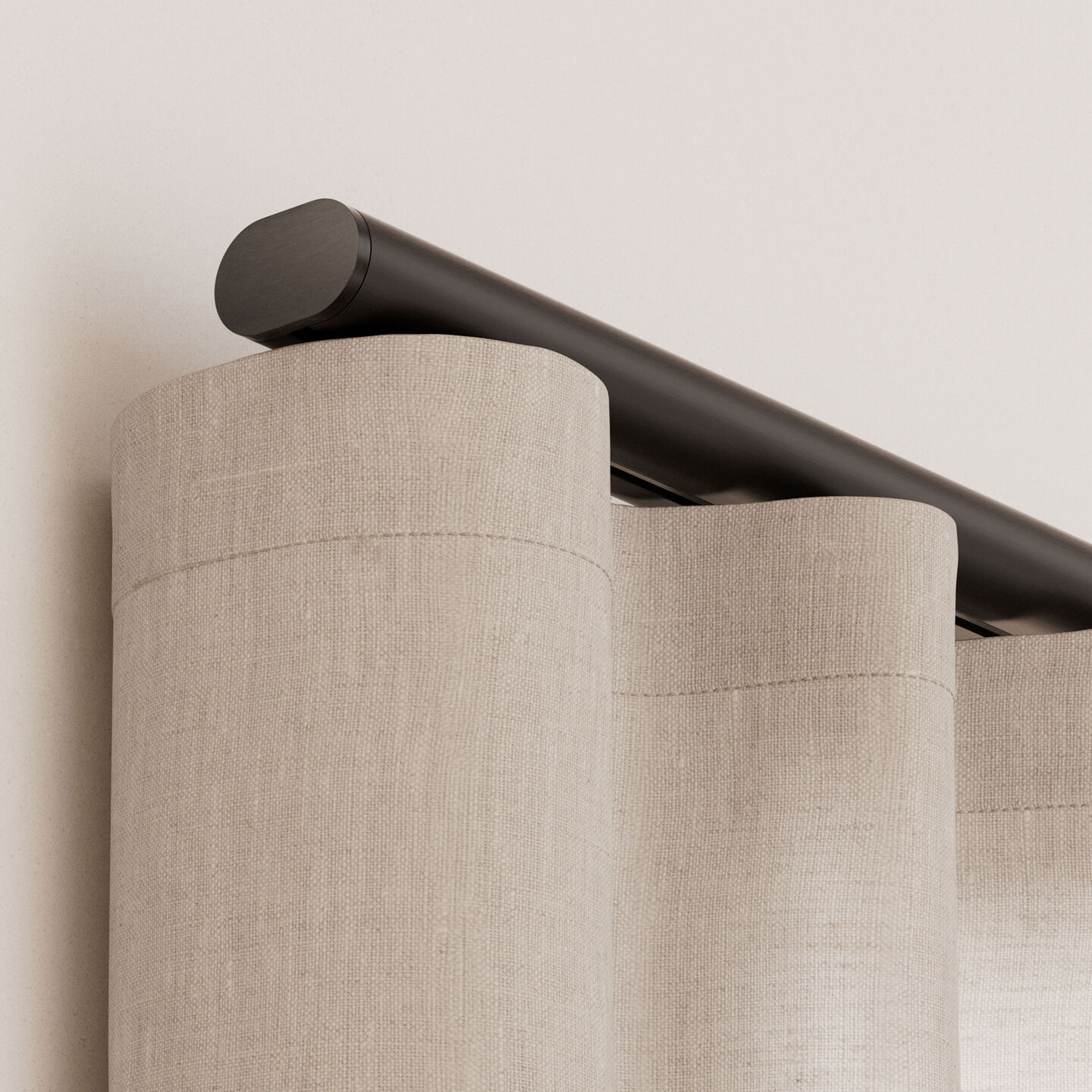
Interior designers frequently describe drapery using workroom terms such as triple pleat, French pleat, tailored pleat, inverted pleat or box pleat. Those are valid custom-fabrication styles, but they should not be confused with a separate Lutron motor category. Lutron’s published track documentation primarily organizes compatibility around Pinch Pleat and Ripplefold.
If a project wants a custom heading, Regent5 coordinates with the drapery workroom so carrier spacing, fabric weight, hooks, fullness and stack-back remain compatible with the motorized track. The decorative specification and the motor specification have to meet in the same physical system.
Not every room needs an exposed Palladiom track. Lutron’s broader Sivoia drapery family is the better tool when the track should disappear, when the run is curved, or when a heavier custom treatment requires a more traditional motorized-track architecture.
Current Sivoia drapery configurations can include one-way draw, center draw, single, dual and tandem arrangements, with different drive sizes selected according to fabric weight and track design. Curved track applications should be laid out early so the radius, stack-back and carrier movement are resolved before millwork or plaster creates an opening the track cannot follow.
A concealed track is one of the cleanest details in a contemporary home. The drapery seems to emerge directly from a ceiling slot, while the motor, rail and attachment hardware remain visually quiet.
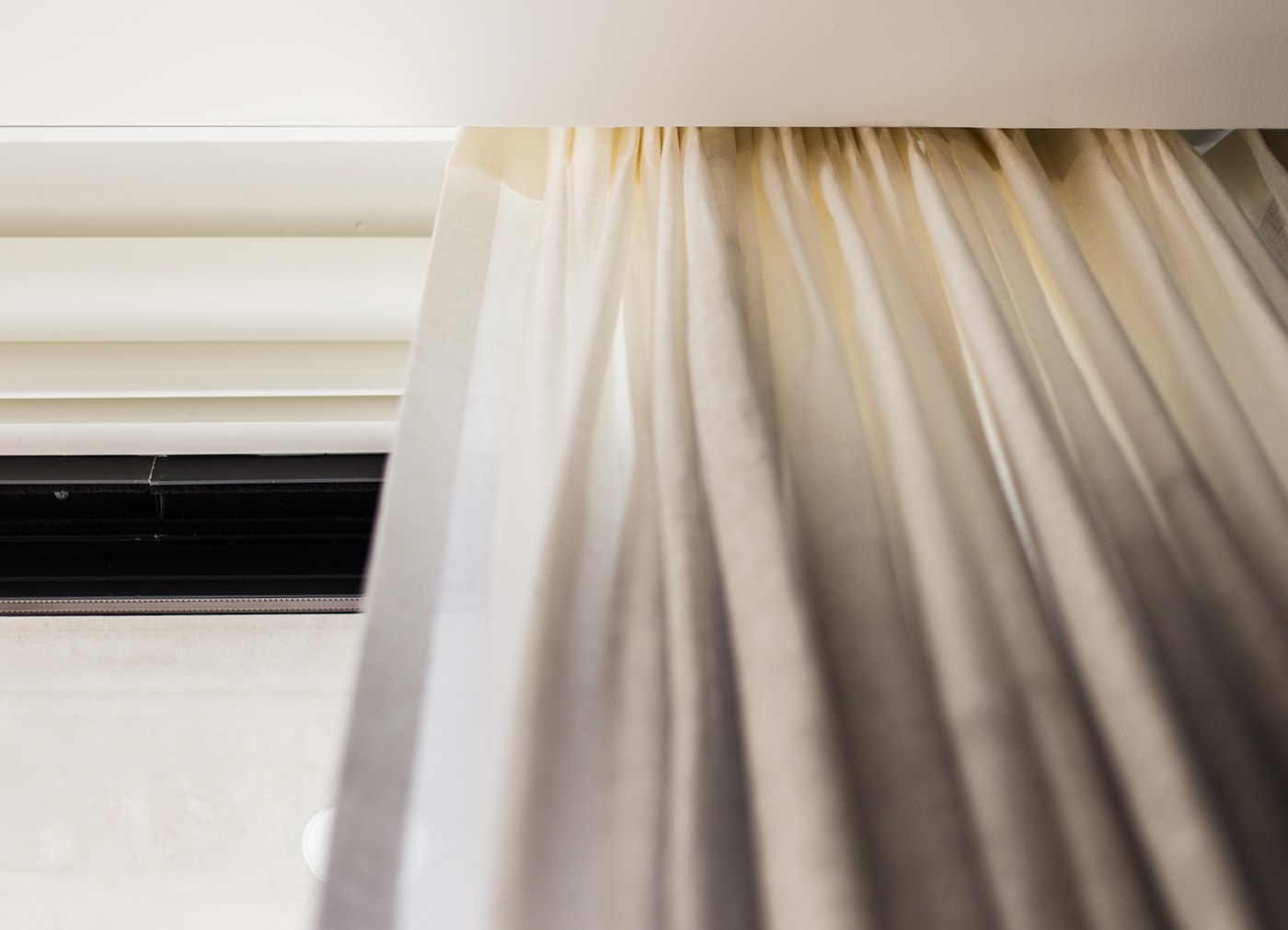
Blindspace’s TrackTrim system is one tool we use for projects that want a flush architectural reveal around manual or electric curtain tracks. Blindspace specifically lists compatibility with Lutron and offers straight and curved recessed-track approaches. These details are most successful when the trim profile is placed on the architectural drawings before drywall, plaster or millwork is installed.
Roman shades are often the right answer when the interior needs more textile character than a flat roller shade provides. The fabric folds as the shade raises, creating depth and softness in kitchens, bedrooms, libraries, sitting rooms and traditional or transitional interiors.
Lutron’s current Roman-shade approach uses fabrication kits that allow a qualified workroom to build a custom Roman treatment around Lutron drive technology. The current portfolio includes both wire-free/battery-oriented Triathlon fabrication approaches and low-voltage Sivoia options. Exact finished size, fabric weight and fold geometry need to be reviewed with the workroom rather than inferred from the motor alone.
This is also where Lutron’s Native by Design ecosystem becomes especially valuable. Partners such as Shading Source and Hartmann&Forbes bring custom workroom craftsmanship and natural woven materials into motorized Lutron applications, while CONRAD adds another distinctive handwoven natural-fiber direction.
For interior designers who want window coverings to read as material rather than technology, CONRAD is particularly interesting. Lutron’s Native by Design program describes the collaboration as pairing CONRAD’s handwoven natural-fiber window coverings with Lutron intelligent shade drives.
The design opportunity is substantial: woven grasses, fibers and natural textures can become a visible layer of the room while Lutron provides quiet motorization and integration with the broader control system. That means a project does not have to choose between bespoke material character and automated operation.
Exact fabric, roller construction and motor compatibility should be confirmed for the selected CONRAD treatment; not every handcrafted product should be assumed to support every Lutron shade drive.
Overhead glazing is one of the places where motorization moves from convenience to necessity. A manual treatment ten or twenty feet above the floor is not a practical daily interface.
Lutron’s Sivoia tensioned systems are designed for applications where gravity alone cannot keep the fabric controlled, including angled glazing and skylights. Tension keeps the fabric taut as it travels across a non-vertical plane, and the architecture can be designed around recessed housings or pockets so the treatment disappears when open.
Skylights require earlier coordination than ordinary vertical windows. The design team needs to know the glazing angle, shade direction, pocket depth, service access, structural blocking, power pathway and whether side guidance is required before the ceiling assembly is complete.
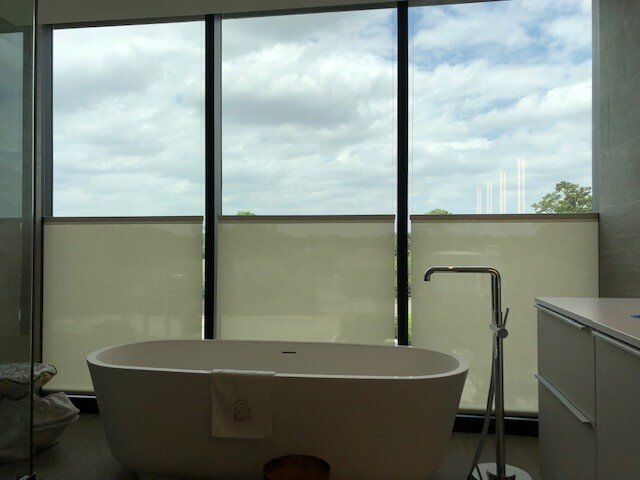
Bottom-up shading is one of the most useful strategies for view-oriented homes. Instead of dropping fabric from the head of the window, the shade rises from below. It can screen a road, neighboring property, pool deck or public sightline while leaving the upper glass open to sky and landscape.
Some bottom-up conditions can be engineered through Lutron tensioned shading; others are better handled through a specialty fabricator using a compatible Lutron motor platform.
Custom architecture frequently creates openings that standard roller products cannot solve cleanly: triangular windows, angled heads, peaked glazing, unusually wide bays and corner conditions.
Regent5 works with Crown Shade on specialty applications where a custom mechanical solution is required around Lutron-compatible motorization. Crown’s current specialty offering includes straight-hem bottom-up shades, angled and peaked-hem shades, and heavier-duty three-sided bottom-up systems for interior and exterior applications.
The important point for architects is that these openings should not be handed to the shading contractor after framing. Geometry, pocket location, side channels, fabric travel and service access all affect what can actually retract cleanly.
People often search for Lutron top-down shades, but this phrase can describe several different mechanisms. We do not treat a generic top-down roller as a universal standard Lutron catalog product. Current verified Lutron solutions are stronger around conventional top-down rollers, bottom-up/tensioned systems, cellular products and partner-fabricated specialty treatments.
If the design intent is to cover the upper portion of a window while leaving the lower glass open—or to create a treatment that moves from both directions—the project should be engineered around the exact opening and specialist fabrication method rather than ordered from a generic “top-down” description.
Exterior shading is particularly relevant in California because it can improve the usability of covered patios, outdoor kitchens, pool pavilions and indoor-outdoor rooms before sunlight and glare reach the interior glass.
Regent5 uses Insolroll Oasis exterior shading with Lutron drives for projects that need the outdoor treatment to participate in the same control language as the rest of the property. Insolroll is a Lutron Native by Design partner, so the relationship is built around shades engineered from the start for Lutron motorization rather than an improvised third-party motor swap.
Current Oasis options include the compact 2700 patio shade, larger 2800 patio shade, 2900 retractable insect screen and 2950 patio/insect-screen systems. Depending on the model, applications can address large openings, solar control, insect protection and captured-edge tensioning.
Outdoor engineering is different from interior shading. Wind exposure, mounting substrate, drainage, corrosion, fabric selection and safe operating limits all matter. Any published wind-performance figure should be treated as manufacturer-rated performance for a specific configuration—not permission to ignore site engineering or weather conditions.
A recessed roller pocket is one of the cleanest ways to integrate a motorized shade. When the shade is raised, the fabric and roller disappear above the ceiling line and the window reads as architecture rather than equipment.
The pocket must be sized around the actual roller family, fabric roll diameter, hembar, fascia or closure detail and service strategy. A pocket drawn as a generic rectangle before the shade model is selected is a common source of field compromises.
For new construction, Regent5 coordinates the shade schedule with the reflected ceiling plan, framing, glazing and electrical/low-voltage drawings through our residential technology preconstruction and engineering process.
There are three broad ways to resolve the top of a roller shade: hide it in a pocket, cover it with a fascia, or celebrate it as exposed hardware. Reverse-roll configurations can also move the fabric farther from the glass or change how it clears handles and trim.
A minimalist project may want a fully recessed pocket. A remodel may favor a slim fascia. A Palladiom room may intentionally expose the roller and bracket. The right answer depends on architecture, not on a universal hierarchy of “better” and “worse.”
The motor is only half the system. Fabric determines what the shade actually does to daylight.
Blackout fabrics are appropriate for bedrooms, nurseries, media rooms and spaces where room darkening matters. The fabric itself may be opaque, but complete darkness depends on the installation. Light can still leak at side gaps, sill conditions and the top of the treatment. For true room-darkening performance, we evaluate side channels, sill closure, dual shades or layered drapery.
Translucent fabrics soften daylight and provide visual privacy without making a room feel closed. They are useful where the design wants a luminous window rather than a preserved exterior view.
Sheer and solar fabrics preserve more connection to the exterior while controlling glare. “Openness” is the useful specification concept. Common solar-screen openness factors include roughly 1%, 3%, 5% and 10%: lower openness generally gives stronger glare/privacy control and less view-through; higher openness preserves more of the view.
Fabric color matters as well. Darker solar fabrics often provide a clearer outward view and strong glare control, while lighter fabrics can make the interior feel brighter and more diffuse. The correct choice depends on orientation, exterior brightness, desired privacy and interior palette.
Some performance fabrics incorporate reflective or metallized characteristics intended to manage solar gain more aggressively. These should be selected with actual glazing orientation and visual goals in mind; a fabric that performs well on a west-facing great room may be unnecessary on a protected north elevation.
Natural fibers, handwoven materials and custom textiles change the role of the window treatment from technical layer to visible interior material. CONRAD, Hartmann&Forbes and custom Roman/drapery workrooms give designers ways to bring texture into the same motorized control strategy.
One shade fabric cannot always solve daytime glare, nighttime privacy and blackout equally well. A dual treatment lets each layer do one job.
A common primary-suite strategy is a sheer or solar roller for daytime plus a blackout roller for sleeping. A formal living room may combine a performance roller with decorative drapery. A media room may pair blackout roller fabric with side channels and a decorative textile layer.
Layering needs to be resolved in section. Two rollers require more pocket depth than one; drapery stack-back can conflict with shades at corners; and the front-to-back relationship affects which treatment is visible when both are open.
Roller shades are not the only motorized Lutron window treatment. Current Lutron residential offerings also include authentic wood blinds and horizontal sheer blinds. Wood blinds add a more traditional architectural material, while horizontal sheer products combine translucent fabric with adjustable vanes for more nuanced privacy and light control.
These treatments are useful when a project wants more than a binary “shade up / shade down” experience. Tilting slats or vanes can redirect light while maintaining partial privacy.
Wire-free is a design advantage when the building is already finished. It reduces invasive wiring and can make selective upgrades practical.
Low-voltage hardwired power is usually preferable when the project is still open. It removes battery service from a large whole-home installation and creates permanent infrastructure for dozens of treatments.
Neither choice is inherently more “luxurious.” The right answer follows the construction phase, number of windows, access and long-term service plan.
The best shading experience happens when the shades become part of the same scene logic as lighting. With Lutron HomeWorks or an appropriately designed RadioRA 3 system, keypads can operate individual treatments, rooms, elevations or whole-home scenes.
A Morning scene can raise selected shades and establish brighter lighting. An Afternoon scene can reduce direct solar exposure on one elevation. Entertain can preserve views in public rooms while closing privacy shades elsewhere. Goodnight can lower bedroom and street-facing shades with a single command.
Lutron also offers Natural Light Optimization on compatible systems, allowing shading to respond dynamically to daylight conditions and time-based strategies. We treat this as a comfort, glare and daylight-management tool—not as a medical claim.
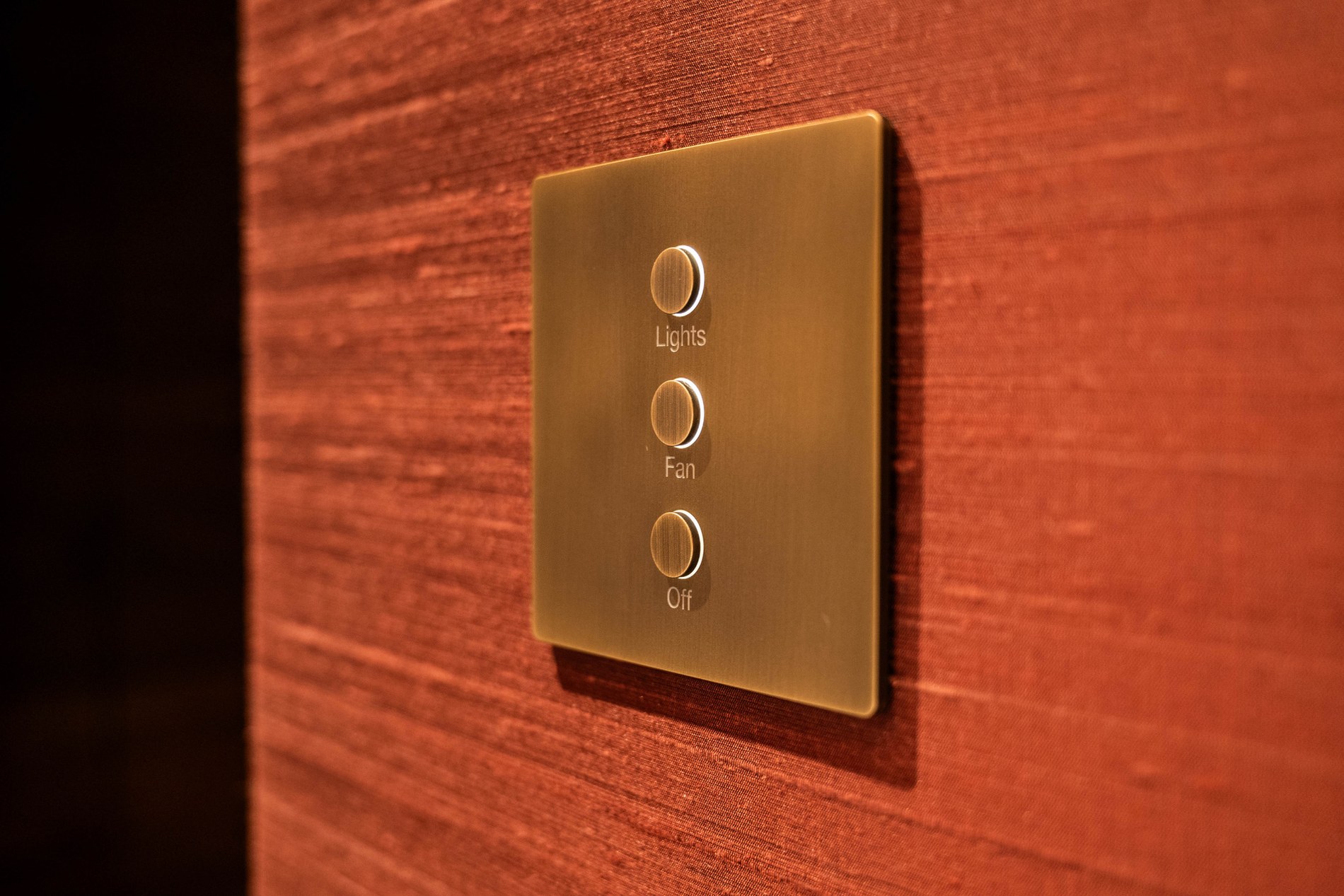
For keypad styles and finish coordination, see our Lutron Aviena, Alisse, Palladiom and Sunnata keypad guide.
1. Shade type and direction. Roller, Roman, drapery, blind, tensioned, bottom-up or exterior screen.
2. Power method. Wire-free battery or low-voltage power.
3. Pocket, fascia or exposed hardware. This changes framing and finish details.
4. Fabric and performance goal. Sheer, solar, translucent/privacy, blackout, decorative or dual-layer.
5. Window hardware conflicts. Handles, doors, mullions and trim affect fabric travel and roll direction.
6. Control system. HomeWorks, RadioRA 3 or another compatible Lutron architecture determines scene control and RF planning.
7. Service access. Motors, batteries, tracks and pockets must remain maintainable after the house is finished.
8. Interior-design coordination. Fabric samples, hardware finishes, drapery fullness and keypad finishes should be reviewed together.
Our technology, lighting and shading guide for interior designers covers this design coordination in more detail.
Great rooms: preserve the view during the day, control late-afternoon glare, and consider concealed rollers or exposed Palladiom depending on the architecture.
Primary bedrooms: daytime solar/sheers plus blackout performance at night; often the strongest candidate for dual shades or shade + drapery layering.
Kitchens: simple cleanable solar or privacy rollers are often more practical than heavy decorative fabrics around active work zones.
Dining rooms: decorative drapery, Roman shades or woven materials can add texture where the treatment is part of the interior composition.
Media rooms: blackout, edge control and scene integration matter more than preserving daytime views.
Bathrooms: privacy, humidity exposure and easy operation are priorities; Palladiom can be especially attractive where the hardware is visible.
Skylights: use tensioned systems engineered around the exact slope and pocket condition.
Patios and outdoor rooms: exterior Insolroll screens can manage glare, comfort and insects before those conditions reach the living space.
Regent5 designs, specifies, installs, programs and services motorized shades and drapery for custom homes throughout the San Francisco Bay Area and Northern California, including San Francisco, Atherton, Woodside, Portola Valley, Hillsborough, Menlo Park, Palo Alto, Los Altos Hills, San Jose, Saratoga, Los Gatos, Marin, Napa and Sonoma, and Carmel and Pebble Beach.
Select project coverage extends through Santa Barbara, Los Angeles and Orange County.
Our role can begin with a single finished-room retrofit or during preconstruction for a whole-home shade package. On larger residences, we coordinate the window schedule, electrical/low-voltage power, pockets, control architecture, fabric strategy, keypads, programming and commissioning rather than handing those decisions from trade to trade.
For a narrower look at roller-shade families, see our Lutron Palladiom, Sivoia and Triathlon comparison. For a broader project discussion, visit our motorized shading systems page or contact Regent5 to schedule a shading consultation.
Yes. Palladiom Wire-Free uses replaceable D-cell batteries and is designed for premium exposed roller applications where bringing new shade power to the window may be undesirable.
Not universally. Hardwired power is often preferable in new construction because it eliminates battery service across many windows. Wire-free is extremely useful in finished homes and selective remodels. The visible design language can remain similarly refined.
Not necessarily. Power and communication are separate design choices. Applicable Lutron shade configurations can have hardwired power while communicating through Lutron RF. The exact architecture should be confirmed for the selected drive and control system.
Palladiom Drapery is Lutron’s design-forward automated drapery family. It combines an exposed curtain-pole aesthetic with a powered track and is intended for custom fabrics in refined residential and hospitality-style interiors.
Yes. Pinch Pleat and Ripplefold are the principal heading styles documented by Lutron. Custom workrooms can create other pleat styles when carrier spacing, fullness, weight and hardware compatibility are engineered appropriately.
Yes. Lutron offers Roman fabrication approaches for professional workrooms, including wire-free and low-voltage drive strategies depending on the selected system.
Yes, through properly engineered tensioned applications. Skylights and angled glazing require system-specific tension, pockets, power and service access.
The phrase “top-down shade” is used loosely in the market. We do not treat a generic top-down roller as a universal standard Lutron product. For unusual travel directions, dual-direction privacy or specialty geometry, Regent5 evaluates Lutron tensioned systems and specialist fabrication partners for the actual opening.
Yes. Regent5 uses Insolroll Oasis exterior systems with Lutron drives for selected patio, solar-control and insect-screen applications. Insolroll is part of Lutron’s Native by Design motorization ecosystem.
Blackout fabric is opaque and intended for room darkening. Solar fabric is a woven screen that reduces glare while preserving some view-through. Solar fabrics are commonly specified by openness percentage; lower openness generally gives more privacy/glare control, while higher openness preserves more of the exterior view.
Yes, when the project is designed around a recessed pocket or concealed track with sufficient depth and service access. This detail should be coordinated before framing and drywall rather than improvised after the shade has been ordered.
During design development, before final reflected-ceiling plans and electrical rough-in. Early involvement allows the team to coordinate pockets, power, blocking, tracks, glazing conflicts, fabric strategy and control scenes while changes are still inexpensive.
Lutron Residential Window Treatments
Lutron Shades
Lutron Blinds
Lutron Drapery
Lutron Fabric Portfolio
Lutron Native by Design
Insolroll x Lutron Oasis Patio Shades
Crown Shade Specialty Rollers
Blindspace Recessed Curtain Tracks
Manufacturer product names, photography and trademarks belong to their respective owners. Final size limits, power requirements, fabrics, ratings, integrations and installation details must be confirmed against the current manufacturer submittal for the selected model.


.svg)

© 2024 Regent5, LLC. CSLB C10 & C7 License 1033103.